

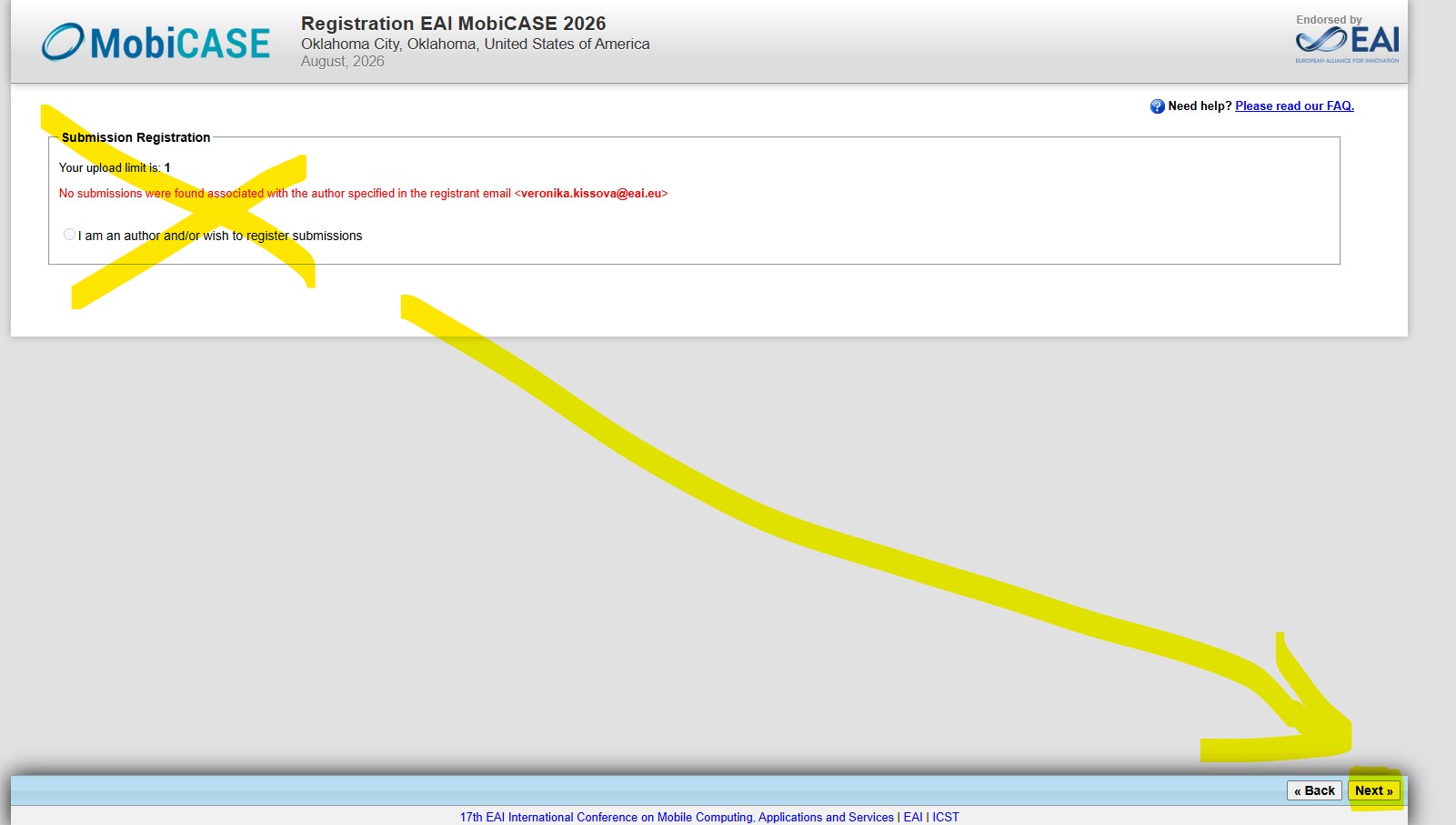
- IMPORTANT: In the registration form, make sure that the Registrant details (name, affiliation, email address) match the details of one of the authors added during Initial Submission.
- Complete the payment. It is recommended that you pay with a credit card due to the speed of the transaction. Please note that if you choose to pay via wire transfer, you will only receive the Camera-ready upload rights after the transaction has been completed, which may take up to 5 business days.
Please Note:
You are not required to select your paper during the registration process. This is because paper submissions were collected in EasyChair rather than through the Confy+ system.When registering, simply skip the paper selection step by clicking “Next” to proceed.
Confy+ Click here to login
If you are a new user, create an account with Confy+ on the homepage of the system.
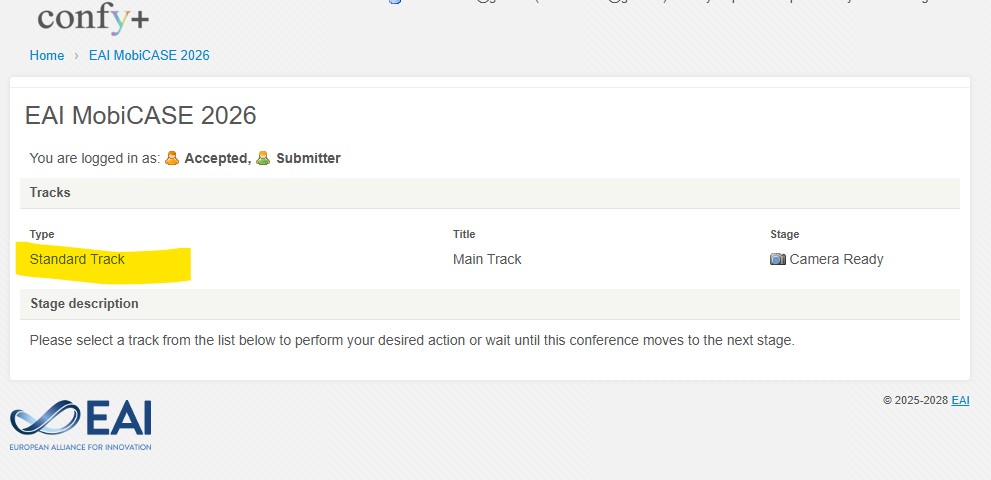
- Click on “My Conferences”, select EAI MobiCASE 2026, and then click on the “Standard track” here:
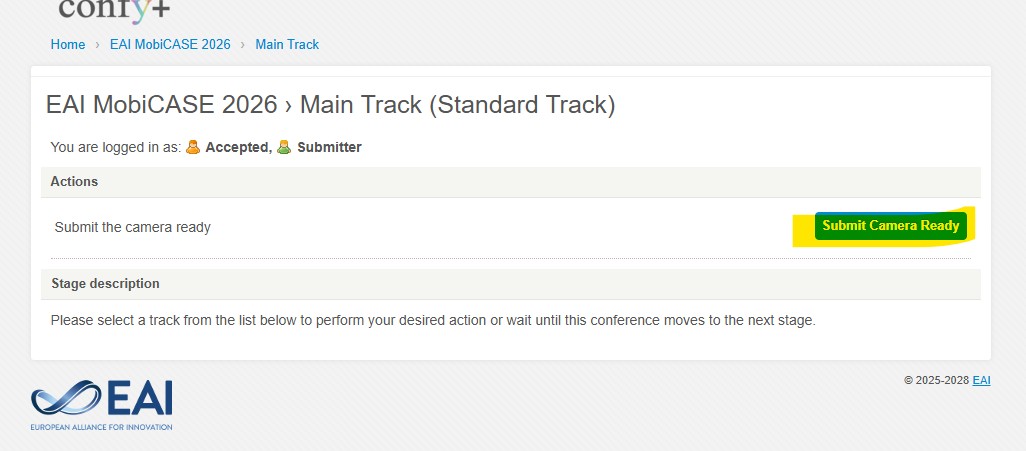
- After that, click on the “Submit Camera Ready” blue button:
- Fill in the required fields and accept the terms and conditions.
*(possible only until the Camera-ready deadline)
1. Find your Camera-ready submission on the Confy+ homepage – in the section “List of My Full Submissions”,
2. Click on your Camera-ready submission,
3. Click the “Edit” button. Please note that it is not possible to create new Camera-ready submissions. All changes to your Camera-ready submission should be done via the method outlined above.
Papers must be formatted using the Springer LNICST Authors’ Kit.
Instructions and templates are available from Springer’s LNICST homepage:
- LaTeX2e Proceedings Templates (zip)
- Microsoft Word Proceedings Templates (zip)
- HOW TO WRITE GOOD ALT TEXT (pdf)
Please make sure that your paper adheres to the format as specified in the instructions and templates.
When uploading the camera-ready copy of your paper, please be sure to upload both:
- a PDF copy of your paper formatted according to the above templates, and
- an archive file (e.g. zip, tar.gz) containing the both a PDF copy of your paper and LaTeX or Word source material prepared according to the above guidelines.
For full information, click HERE.
AI Authorship Policy
Large Language Models (LLMs), such as ChatGPT, do not currently satisfy our authorship criteria. Notably an attribution of authorship carries with it accountability for the work, which cannot be effectively applied to LLMs. We thus ask that the use of an LLM be properly documented in the Acknowledgements, or in the Introduction or Preface of the manuscript.
The use of an LLM (or other AI-tool) for “AI assisted copy editing” purposes does not need to be declared. In this context, we define the term “AI assisted copy editing” as AI-assisted improvements to human-generated texts for readability and style, and to ensure that the texts are free of errors in grammar, spelling, punctuation and tone. These AI-assisted improvements may include wording and formatting changes to the texts, but do not include generative editorial work and autonomous content creation. In all cases, there must be human accountability for the final version of the text and agreement from the authors that the edits reflect their original work. This reflects a similar stance taken on the AI generative figures policy, where it was acknowledged that there are cases where AI can be used to generate a figure without being concerned about copyright e.g. to generate a graph based on data provided by the author.
AI Authorship Guidance
Authors should familiarise themselves with the current known risks of using AI models before using them in their manuscript. AI models have been known to plagiarise content and to create false content. As such, authors should carry out due diligence to ensure that any AI-generated content in their book is correct, appropriately referenced, and follow the standards as laid out in our Book Authors’ Code of Conduct.
AI-generated Images Policy
The fast-moving area of generative AI image creation has resulted in novel legal copyright and research integrity issues. As publishers, we strictly follow existing copyright law and best practices regarding publication ethics. While legal issues relating to AI-generated images and videos remain broadly unresolved, Springer Nature journals and books are unable to permit its use for publication.
Exceptions:
- Images/art obtained from agencies that we have contractual relationships with that have created images in a legally acceptable manner.
- Images and videos that are directly referenced in a piece that is specifically about AI and such cases will be reviewed on a case-by-case basis.
- The use of generative AI tools developed with specific sets of underlying scientific data that can be attributed, checked and verified for accuracy, provided that ethics, copyright and terms of use restrictions are adhered to.
* All exceptions must be labelled clearly as generated by AI within the image field.
As we expect things to develop rapidly in this field in the near future, we will review this policy regularly and adapt if necessary.Note: Examples of image types covered by this policy include: video and animation, including video stills; photography; illustration such as scientific diagrams, photo-illustrations and other collages, and editorial illustrations such as drawings, cartoons or other 2D or 3D visual representations. Not included in this policy are text-based and numerical display items, such as: tables, flow charts and other simple graphs that do not contain images. Please note that not all AI tools are generative. The use of non-generative machine learning tools to manipulate, combine or enhance existing images or figures should be disclosed in the relevant caption upon submission to allow a case-by-case review.
AI-generated Images Guidance
For more information on the inclusion of third party content (i.e. any work that you have not created yourself and which you have reproduced or adapted from other sources) please see Rights, Permissions, Third Party Distribution.
